

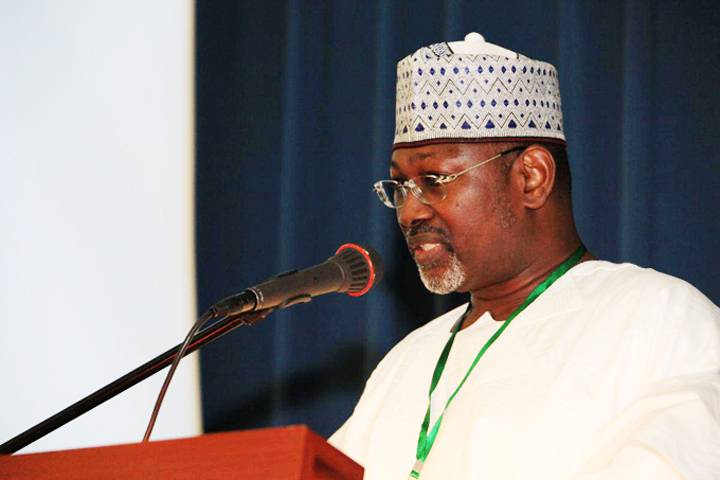
Former Chairman of the Independent National Electoral Commission (INEC), Prof. Attahiru Jega, expressed disappointment over the attitude of some politicians in the country.
He said this while speaking on Thursday, at the first University of Abuja Public Lecture Series, tagged: Electoral Reforms in Nigeria: Challenges and Prospects. He disclosed that the 2007 elections were arguably the worst in Nigeria’s history, describing Nigerian politician’s mindset to electoral process as ‘predisposition and reckless.’
He said: “From my experience, I quite often say that Nigeria has a special breed of politicians (Nee: ‘Militicians’). They generally tend to believe that political power through elections has to be “captured”, and this has to be done by hook or by crook; and by any means necessary! Them, winning election is, literally, “a do-or-die” affair.”
“As long as politicians continue to have this unwholesome mindset, efforts at electoral reform and deepening democracy would remain constrained.”
More so in his words: “INEC faced perhaps its greatest challenge in containing the predisposition and reckless mindset of Nigerian politicians. Any wonder then, that our political arena increasingly resembled a bloody battlefield, with maiming, killing, burning, and unimaginable destruction of lives and property. Navigating the ‘minefield’ of ‘do-or-die’ politicians as an impartial electoral umpire required nerves of steel, and we had to quickly the requisite thick skin, as well as appropriate containment strategies.
“Compliance with the laws and insisting on same and respect for due process, as well as being none partisan and transparent, helped the Commission in navigating this ‘minefield.”
He advised government to ensure that security plays a wise roll in future elections.
He further added that: “A series of badly conducted elections could create perpetual political instability and easily reverse the gains of democratization. If adequate care is not taken, badly conducted elections can totally undermine democratization and replace it with authoritarian rule, of the civilian or military varieties. At best, they can install inept and corrupt leadership that can herald, if not institutionalize bad governance. There are many illustrations or manifestations of this throughout Africa. But nowhere is this as amply illustrated as in the Nigerian case, especially between 1999 and 2007.
“The 2007 elections were manifestly the worst in Nigeria’s history, as declared by both domestic and international observers. The EU observer mission, for example, noted that the elections fell “short of basic international standards”, and were characterized by violence and crude use of money to buy votes.
“There was reckless mobilization of ethno-religious cleavages and heightened use of money and thugs to influence results. The pre-electoral processes, such as party primaries were conducted in grossly undemocratic fashion. In many cases, the results were said to have gone to the highest bidder. The winner of the presidential election, late President Umaru Musa Yar’adua, himself admitted on the day of his inauguration, that there were serious flaws in the election that brought him to power.
“There are also other associated challenges. For example, meeting the production deadlines in the production of PVCs was seriously affected by power failures, which damaged equipment, which the vendor could not quickly replace. The use of the SCR was constrained by the fact that some polling units are located in areas where there was no Internet coverage! Or in schools, which used as Super RACs, with no electricity to charge batteries and SCRs!”
He urged the youths to be interested in the electoral reforms for a better country.
In his closing renarkes, He commended President Muhammadu Buhari over the choice of his successor affirming that he can do the job. He went further by advising government to sustain the current ongoing reforms in the electoral process and ensure that the players and other stakeholders abide by the rule at all time.


