

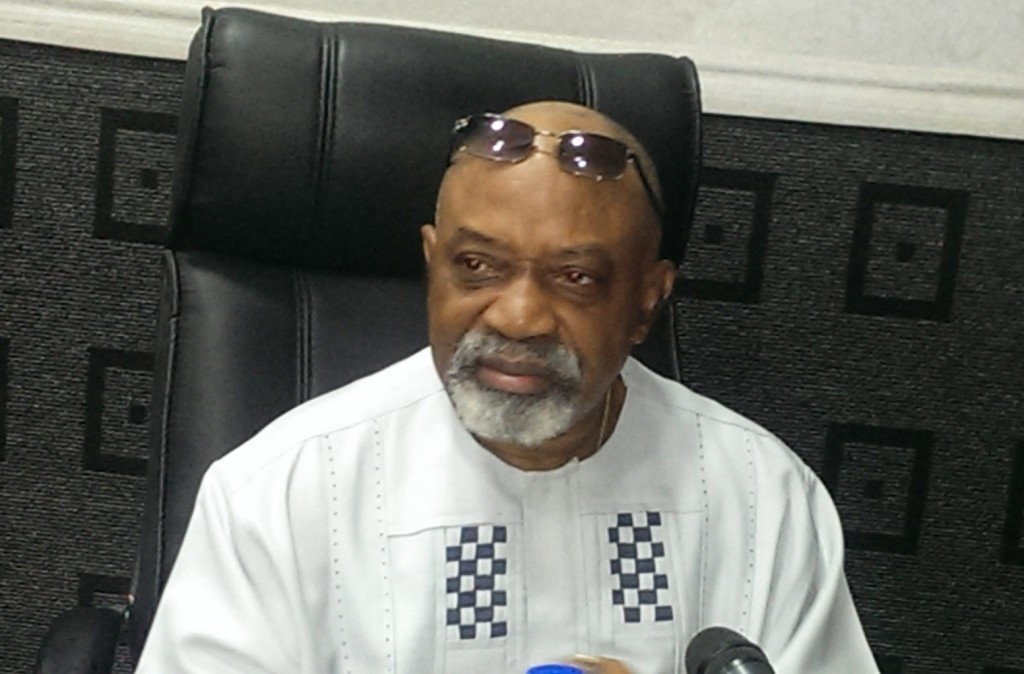
The Federal Government of Nigeria may layoff workers to meet up with the demand for a new minimum wage.
According to Dr. Chris Ngige, the Minister of Labour and Employment, the demand of labour over the implementation of the new minimum wage would cost the Federal Government N580 billion annually.
The Minister disclosed these on Thursday in Abuja when the leadership of United Labour Congress (ULC) led by its President, Mr Joe Ajeiro, paid him a courtesy visit at the ministry.
He said FG would find it difficult meeting up labour’s demand, as it lacks the capacity to sustain it.
He noted that, for FG to meet up with labour’s demand, government would have to lay off some workers.
He added that the focus of the President Muhammadu Buhari’s led-administration, is on workers on grade level 1 step 1 and level 6 step 1 where the impact of the wage would be felt by workers.
He said that the government was avoiding a situation where it would have to lay off workers, adding that this would add to the burden of the citizenry.
Ngige appealed to the labour to accept the consequential adjustment from levels 7 to 17, adding that the federal government had only three months left to implement the new minimum wage.
“There is no problem with disagreement in the labour system, when can sometimes disagree to later agree, on the national minimum wage, it will translate to an additional N580billion if government agrees to the consequential adjustment labour is proposing,” Ngige said.
“Government cannot afford that kind of money now, besides the administration of President Muhammadu Buhari is more interested in the lowest cadre of workers which are those on grade level 1 step 1 and level 6 step 1, these are the ones who the N30,000 will have greater impact on.
“Government has done their own homework and brought out what they can use to defend this consequential adjustment. Grade 1 to 6 does not have any problem, but 7 to 14 band and 15 to 17 band this is where we have the problem.
“Once you finish a minimum wage and go into consequential adjustment you are trying to reach a collective bargaining agreement and once you are trying to reach and once you are the principle of ability to pay comes in.
“So if you push government to go and accede to an increment which its resources cannot accommodate, you are indirectly asking them to retrench workers so that the few that are remaining will get this big big money.
“We don’t want that, from 2015 the president has made it clear that he is not out to inflict pains on Nigerians and that he does not want to create unemployment but even at that our increase in population is galloping and our resources is not consequentialy increasing to meet up that is why we have a lot of unemployed youths on the street today.
“We need to arrive at an agreement as soon as possible so that we can use the 2019 budget allocation to deframe this consequential adjustment because it will be bad if we are unable to do it and we finish this financial year by December because the budget circle is going to return to January/December 2020 so we we have three months only before this recurrent funds as well are swept back into government treasury, that is the law.”
He regretted the inability of the joint negotiating team of both the government and labour to agree on the consequential adjustments, insisting that the new wage may become bloated by workers on grade levels 7-14 and 15-17.


